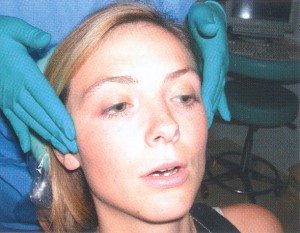
What are they?

The joint between your upper and lower jaws, just in front of your ears, is called the temporomandibular joint ('TMJ' for short). Cartilage (a gristly substance) separates the bone surfaces. The jaw joints can occasionally cause problems, which your dentist can help diagnose and treat.


What are the symptoms?

  • Clicking or grating noises when you move your jaw.
  • Difficulty opening or closing your mouth.
  • Swelling or tenderness over the joint.
  • Pain in the face, neck and chewing muscles (some people also have pain in the shoulders and / or back).
  • Headaches or migraine, especially first thing in the morning.
  • Pain in your can possibly with ringing noises.


Clicking or grating noises are usually down to the cartilage jumping when you open your mouth. The problem can be addressed by:
  • cutting up food into small pieces;
  • avoiding very chewy foods;
  • avoiding very hard foods; and
  • trying not to open your mouth too wide - for example, when you yawn.


Jaw joint pain is usually the result of increased tension in the jaw muscles. Factors involved in this include:
  • grinding or clenching your teeth, in your sleep or during the day; and
  • habits such as biting your nails or chewing a pen.


These are often related to fatigue, stress and anxiety. Painkillers and sedatives can relieve symptoms in the short term. Possible solutions to the underlying problem include:
  • using relaxation and stress-relieving techniques;
  • giving up habits that aggravate the condition; and
  • wearing a 'biteguard' at night, to stop you grinding your teeth in your sleep.


Some, very few, people may be experiencing jaw joint problems due to the way their teeth or dentures meet when they bite. This can be resolved by adjusting the position or the shape of some teeth, by replacing missing teeth with dentures or implants, or by making a new denture, as necessary.


This page last updated: 27/10/2009

The practice The team What our patients say Quality assurance How to find us Areas served
Preventive oral health advice Examination OHS Healthy eating Toothbrushing advice Why you need to brush your teeth Fluoride for children Fluoride for the over 65's Keeping a denture clean Scaling and polishing Fissure sealants Bad breath Tooth erosion
Gum disease Silver fillings Root fillings Apicectomy Extraction Post-extraction advice Wisdom teeth Oral cancer Jaw problems Chronic facial pain Removable dentures Dental implants
Introduction Inlays and onlays Etch-retained restorations Porcelain laminate veneers Tooth whitening Crowns Fixed bridges Tooth coloured fillings