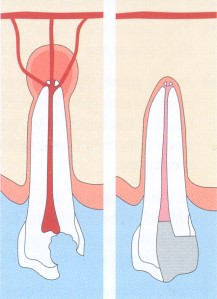
What is it?

Teeth are held in the jaw by their roots.

At the core of each tooth is a soft mass of tissue called the dental pulp. In a healthy tooth, the pulp contains living fibres, cells, nerves and a blood supply, extending into the root(s) through the root canal(s).

Tooth decay or injury can destroy the living pulp. Dead pulp is more prone to infection, leading to an abscess and toothache.

This can usually be dealt with successfully by root canal treatment (also known as root filling or endodontics). Sometimes infection can persist at the end of a tooth root, in the surrounding bone. In this case, a dentist can carry out an apicectomy.


What will my dentist do?

They will:

  • give you a local anaesthetic to numb the mouth around the infected tooth, so that the procedure is painless;
  • make a small cut in the gum, well away from the tooth, so that there won't be a visible scar afterwards;
  • move a small flap of gum to one side, and make a small 'window' in the bone, to uncover the infected area;
  • clean out the infection and cut off the tip, or 'apex', of the root;
  • put a small filling at the end of the root canal to stop any more infection; and
  • stitch the gum back in place.
You may feel some pressure and hear instruments being used, but you should not feel any pain during an apicectomy.

After treatment you will need to keep the area clean.
  • For the first day, rinse with warm salt water several times a day, especially after meals. Use half a teaspoon of salt in a glass of warm water; not hotter than is comfortable.
  • Brush the teeth normally, but be very careful not to disturb the cut.
  • On the next day, continue rinsing and begin to gently brush the teeth next to the cut.
There may be some bruising and swelling for two or three days afterwards. There will also be some slight discomfort - an ice-pack or a packet of frozen peas wrapped in a towel applied to the outside of the face can help. It usually takes about a week for an apicectomy to heal.

Points to remember:

  • An apicectomy stops pain.
  • An apicectomy saves a tooth that would otherwise have to be taken out.


This page last updated: 27/10/2009

The practice The team Quality assurance How to find us Areas served
Examination OHS Healthy eating Toothbrushing advice Why you need to brush your teeth Fluoride for children Fluoride for the over 65's Keeping a denture clean Scaling and polishing Fissure sealants Bad breath Tooth erosion
Gum disease Silver fillings Root fillings Apicectomy Extraction Post-extraction advice Wisdom teeth Oral cancer Jaw problems Chronic facial pain Removable dentures Dental implants
Introduction Inlays and onlays Etch-retained restorations Porcelain laminate veneers Tooth whitening Crowns Fixed bridges Tooth coloured fillings